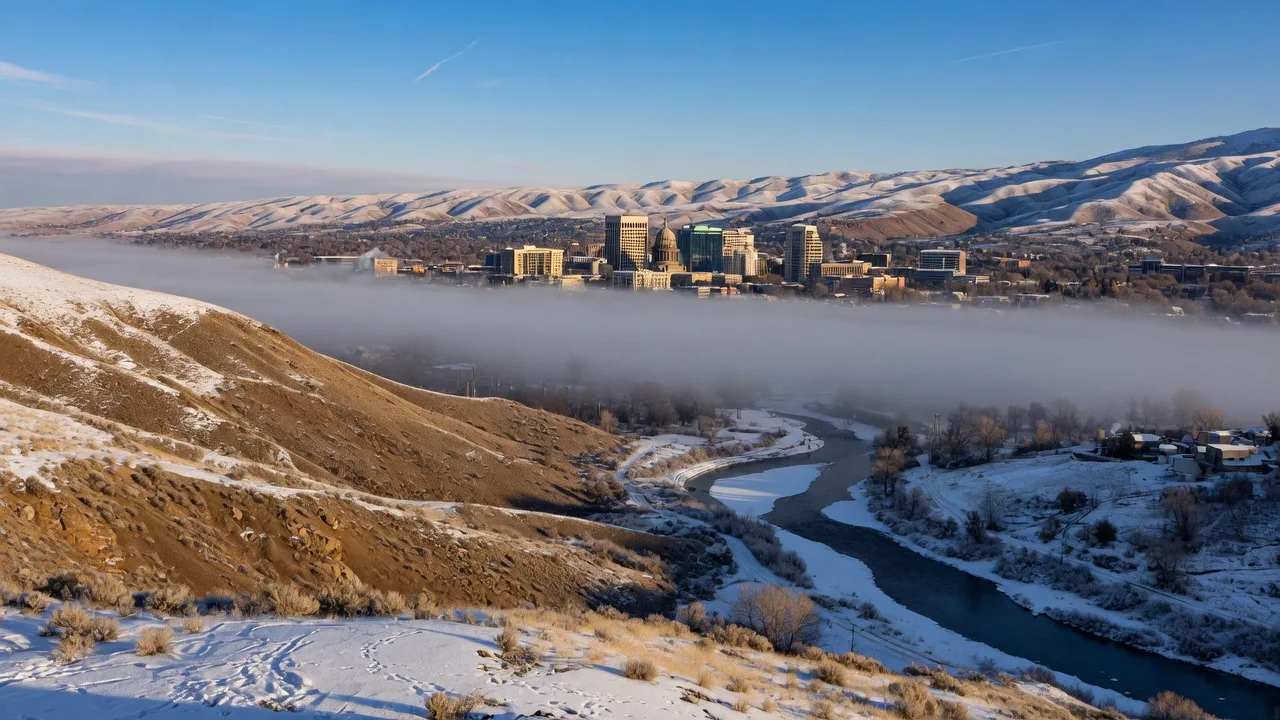
Winter is the season PNW transplants ask us about the most, so here is the honest version before the first freeze: less rain than you are used to, real cold, a little snow, and a surprising amount of sun. Boise winters are shorter and drier than Portland or Seattle winters, and the practical list to get right is short.
How much snow does Boise actually get?
Not as much as newcomers fear. Boise averages about 17.6 inches of snow a season (NOAA/NCEI 1991-2020 normals for Boise Air Terminal), with January normally the snowiest month at about 5.3 inches. The first measurable snow usually does not fall until mid-to-late November, around November 18 to 23 by recent averages, so a dry, sunny October is entirely normal.
The snow also does not stick around the way it does in the mountains. Valley snow melts off between storms, the sun keeps showing up, and by mid-February you will have a clear read on how manageable the season really is.
How cold does the valley get in January?
January is the coldest month: average highs near 39°F and average lows around 25°F (NOAA/NCEI 1991-2020 normals). Cold snaps below zero happen in most winters but rarely last more than a few days. One local quirk worth knowing: the west end of the Treasure Valley, closer to Nampa and Caldwell, routinely runs a few degrees colder than Boise proper under the winter inversions (NWS Boise climate summary).
Do I need studded tires or chains?
For the I-84 corridor through the Treasure Valley, the straight answer is no standing requirement: Idaho's only statutory chain mandates cover the I-90 mountain passes, Lookout Pass and Fourth of July Pass, plus Lolo Pass on US 12, and they apply to commercial vehicles only when the Idaho Transportation Department declares the pass unsafe (Idaho Code § 49-948). During winter storms ITD posts advisory notices such as traction-tire or chain signs, and drivers are required to follow posted signs.
For tires themselves, studded tires are legal in Idaho from October 1 through April 30 only; outside that window they are prohibited and carry a fine (Idaho Code § 49-948). Studless snow tires and all-weather tires are legal year-round, and for most valley driving a good set of all-weather tires plus smooth, patient winter driving is the practical choice. If you plan to ski at Bogus Basin or cross the mountain passes toward Oregon or Washington regularly, studless snow tires are the smarter call.
What are the winter inversions people mention?
An inversion happens when a warm layer of air traps cooler air near the valley floor, and inversions are a recurring part of Treasure Valley winters, mainly December through February (NWS Boise). The visible result is low fog and a gray lid over the valley while the sun shines on the foothills above it. An inversion can last a few days or more than a week, and it can bring stagnant air and elevated air-quality readings, which matters most for people with asthma or young children.
The good news is that inversions break, and the sun returns. Plan outdoor time for the clear days, keep an eye on local air-quality advisories, and you will find the pattern easy to live with.
What should we do before the cold arrives?
- Blow out the irrigation system. Sprinklers left full of water are the classic first-winter break for transplants, so schedule the blowout early because slots fill up fast.
- Check tires and wiper fluid before the first storm. Winter-rated fluid and tires with real tread are the difference between an easy commute and an I-84 adventure.
- Keep a small emergency kit in the car: a shovel, jumper cables, warm layers, and a flashlight cover almost every valley winter emergency.
- Know your water shutoff and unhook garden hoses. A dripping outdoor faucet on a 25-degree night is how pipes crack.
- Embrace the midday sun. January days are bright even when cold, and a 20-minute walk at noon is the best winter mood fix in the valley.
Is winter a good time to move?
For many families, yes. Fewer listings move in December and January, but fewer buyers are looking too, and the ones who commit mid-winter often find a calmer process and more negotiation room. If the logistics work for you, ask us about the current inventory in the town you are eyeing, and we will give you the honest read.
Winter is the shortest and sunniest part of the year to fear, and knowing the list in advance is most of the battle. Ask us about the neighborhoods where snow removal, commutes, and school pickups line up best for your family, and we will help you land your first Treasure Valley winter well.
Verify before you rely
Weather figures are NOAA/NCEI 1991-2020 climate normals for Boise Air Terminal (average annual snowfall 17.6 in, January normals 38.8°F high and 25.1°F low, annual precipitation 11.51 in), first-freeze probabilities per NWS Boise, and first-snow timing per the NWS Boise blog and Idaho Statesman. Tire rules follow Idaho Code § 49-948 and the Idaho Transportation Department studded-tire window of October 1 through April 30. Confirm current conditions with NWS Boise and ITD before you rely on any of it.
Paul Knighton & Tina DeBoer
MORE Realty · Treasure Valley, Idaho